Uod: Intelligent and Less Intelligent Creatures
A variety of intelligent creature and notable animals.
Dwarfs
There are no dwarfs in the sense of the "living-underground, all have beards, sound Scottish or like vikings" separate species from humanity. At least not anymore. There is no evidence of a civilization or culture, but merchants in cities frequently have "dwarf-bone jewelry" for sale.
Little people exist like any other member of humanity, but only differentiated by their short stature. They vehemently dislike being called a "dwarf" and have even great dislike any talk of the value of their bones.
- "Dwarf": N/A
Elfs
"Elf" is typically used a kind of slur. In reality, there are no elfs, just faeriekind who occasionally slip over the subtle borders from their timeless realm. Some particularly mischievous faerie kind will slip into an isolate village and mix in faerie breads along more mundane food supplies, leading some folk to become addicted to the treats of the Seelie Court.
Slowly that infestation manifests in the local populace believing they are elfs. They began to speak using archaic words, get lost in the woods for days, gain a purely psychosomatic reaction to cold iron and take up practice with small bows.
The most dedicated of these "elfs" become more susceptible to charm, sleep, and other enchantments, and will awkward stitch chunks for flesh to make "pointed" ears.
- "Elf": per human.
Gnomes
"Gnome" is now just a slur for short people with big noses. Actual gnomes went extinct long ago when people found them to be a delicacy.
Goblins
Goblins are made, not born. You throw a goblin ear in a barrel with some other gross stuff (fish guts, rotten eggs, sour milk, moldy bread, dog piss) and seal it up for a week, then a full grown is spawned from the ear. It only takes one ear to make a new goblin, so they will decapitate their fallen brothers and resulting in two more years goblins spawned from each of their dead.
Goblins live just below the surface and burrowing into sewers and people's root cellars for the necessary breeding ingredients. Any unfortunate events in below ground are blamed on the work of goblins. The folklore wasn't that inaccurate. Until a fear years, most people were unaware of the massive community of goblins building an invading force beneath Balancont.
- Goblin, Common: Hit Dice 1-1, Armor as leather, Damage: d6 (most weapons), d6+1 smoking ranged contraption.
Hill People
Stolen human babies incubated like fetuses in the stomach of a animal and reborn on the new moon. While most have horns and hooves, many have feature of their parent - tusks, scales, a pig nose, tails, etc. Clothing among their kind is an afterthought - at most a loincloth or scavenged cloth loosely draped over the body like a robe.
Many people claim that Hill People are by nature violent, carnivorous humanoids as likely to consume their own kind as much as the nearest villagers. Others maintain they are peaceful folk who subsist on grass and vegetation like their host animal. Either statement may reveal more about the opinionator rather than a factual insight on the Hill People.
- Hill People: Hit Dice: 1+2, Armor as leather and shield, Damage: as weapon, or horns (d6)
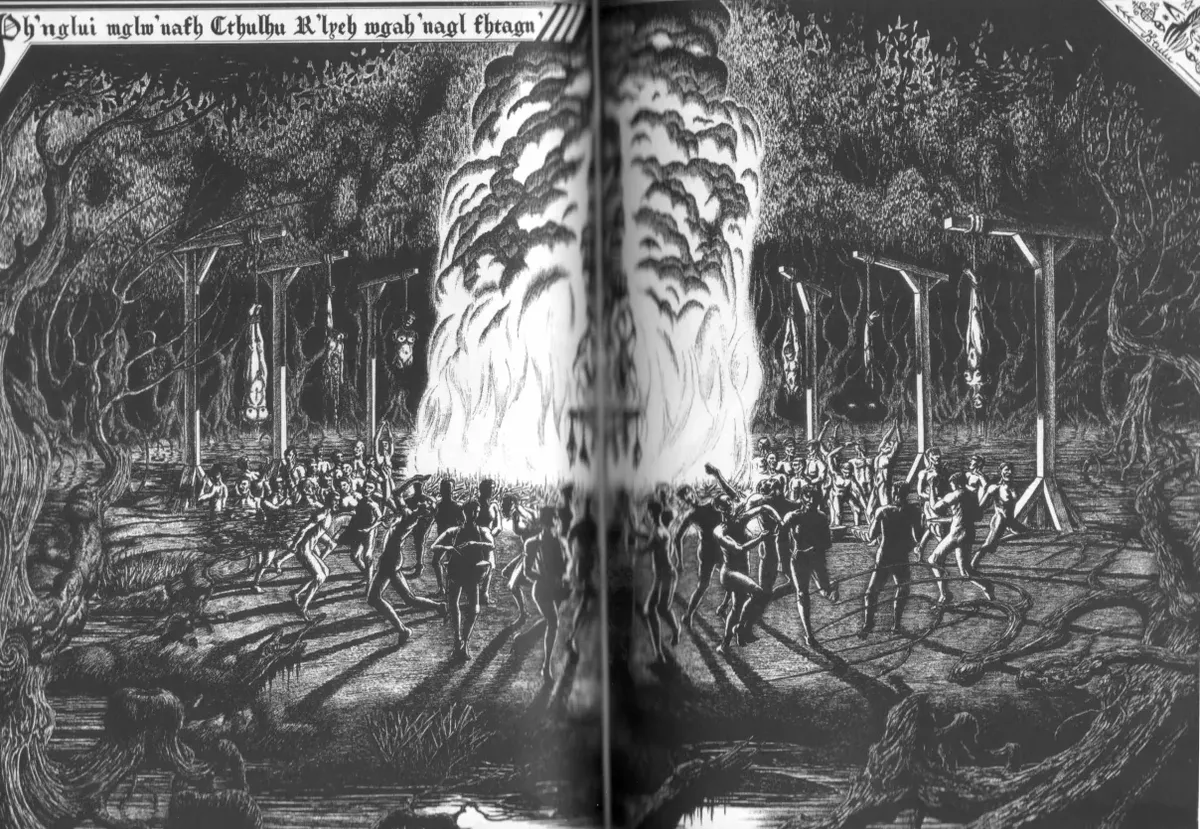 [art by John Coulthart]
Cyclopes
Giants are talked of like legends. The old town drunkard claims he saw one once. Massive bones have been found but no sight of the living by reputable folk. However in the mountains and lonely bogs there Cyclopes - vicious one-eyed humanoids as tall as a windmill. They bully and squash shorter creatures with their immense spiked clubs. Their true spite is reserved for ogres, who return the sentiment.
There are no giants though. Were there ever giants? Just Cyclopes and Ogres, who hate each other.
- Cyclops: Hit Dice: 20, Armor as chain, Damage: 2d8 Spiked Club, 2d12 Thrown Rock.
Ogres
There are two main varieties of ogres, commonly called Northern and Southern. With the exception of a few northern mercenaries it is unheard of for groups to encounter each other, leading to the expression "getting on like ogres" for being in a risky or unknown situation.
Northern Ogres have thick hair on most of the body, except for hands and the head, which is frequently bald. They craft their own weapons and scrap together armor, but otherwise mimic the styles of human cultures in the vicinity. Their broad faces result in exaggerated expressions. The old wives' tale is that they have a perpetual sneer from an abusive childhood.
These ogres rarely live in communities beyond the extended family. They clearly have communication to their fellows nearby as the younger males will gang up together to accost merchants and other travelers. Many work as mercenaries along the coast, fighting skirmishes in the employ of the Heteri warlords or as bodyguards to the wealthy. Most command upward of 10 silver a day as well as a healthy share of plunder.
- Northern Ogre: Hit Dice: 4+2 (some more), Armor as chain + armored mask (treat as shield), Damage: 1d12+2 Kriegsflegel or Huge Sword (treat as Flamberge, +3 to damage) 2d6 Ball & Chain.
 [cropped art by John Blanche]
Unlike their northern cousins, Southern Ogres have largely have abandoned the trappings of men. Clothing in particular, though scraps of lamellar and armored masks may donned when violence is expected. They maintain only the most basic guttural speak, which appears to be completely intelligible and complex to others of their kind. In place of body hair they have developed 6" porcupine-likes needles covering their body from head to toe. Unlike porcupines the needles are always raised and can be launched up to 10' away, typically in moments of dire pain, extreme emotion, or near death.
Unlike Hill People, the "needle ogres" are universally known to be man-eaters. They don't value gold or gems, only meat. An offering of live humans is the only way to negotiate and avoid antagonism and bloodshed.
- Needle Ogre Overseer: Hit Dice 5+1, Armor as plate + armored mask (treat as shield) , Damage: 1d10 Spiked Club, 2d6 Ball & Chain, d4 Needles (to all foes in 10' radius).
- Needle Ogre, Common: Hit Dice 4+1, Armor as chain + armored mask (treat as shield), Damage 1d10 Spiked Club, d10 Harpoon, d4 Needles (to all foes in 10' radius).
Nogs
Doctor Thoad's report for covers most of the irrelevant details. There are three facts one needs to know about nogs:
- They are either cooperative or competent. The more the possess one quality, the more they lack in the other.
- Nogs work harder when you slap them.
- Nogs make excellent sandwiches.
- Nog: Hit Dice: 1, Armor: none (unless working as shield nog), Damage: 1d4 (regardless of weapon).
Ningala
An evolution from quadruped locomotion that dwell in isolated communication. The formerly hind legs have inverse knee joints (actually digitigrade), allowing the species to bend forward at the knees. In modern times this has made bipedal movement slow and awkward, and required special manufacture of full body style armor. Small amounts of hair to rear of head (occipital and parietal lobes) in shades of auburn and gray, but grows rapidly. Olfactory organs are located in a long trunk-like proboscis that hangs to mid throat. Many tunnels and cliffside dwellings are said to be old Ningala construction, which seem unlikely given their physiology.
- Ningala Warrior: Hit Dice: 2+, Armor as plate. Damage: per weapon.
Others Considered Less Intelligent
Mules are quadrupedal beast of burden, with human faces and the vocabulary of a dog, but also the ability to speak those words as well. Some weird mules exist with an equine head, but are rare and without the ability to speak it's cruel to use them for labor, since they can't express themselves. Regardless of the shape of their head, they all are omnivores and love chicken. Expeditions will bring crates of chicken to keep the mule trains moving reliably. "Enough chickens to satisfy a mule" is an expression for an immense amount of something. A trained animal handler is required to make use of multiple mules and they will begin to loudly complain if one is not provided. 75 silver, not including packs.
- Mule: Hit Dice: 2+2, Armor: as leather, Damage: d3 bite, d6+1 kick
Guildayi are a nearly hairless canine species bred for war, three feet at the shoulder. They will begin to howl when within 120’ of undead, but they must feed on bone or corpses weekly or they grow violent towards handlers. Daily requirements are two rations, but little water is craved. Those trained for battle cost 50 silver, with upselling of spiked collars and similar accoutrements being common.
- Guildayi: Hit Dice: 2, Armor: as leather and shield (upgrades common), Damage: 2d4
Chickens: In addition to being a flexible food source, live black and white are chickens are used for gambling. Common varieties are 5 copper a piece, with doubled if combat accessories are included. Particularly well trained and vicious examples of this species can sell for 1000 times normal the common farm variety.
- Chicken: Hit Dice: 1/4 (2 hp, double for gambling variety), Armor: normally none, Damage: 1d6 + accessories.
Pigs are considered one of the smartest animals, but their flavor is more valued than their intelligence. In addition to food uses, a grown pig can devour a human corpse in five days. Use of multiple pigs will reduce this time. 15 silver for one with a proper appetite.
- Pig: Hit Dice: 1 or 2, Armor: as leather, Damage: significant against prone foes.